
CA60 - Schools need (some) colour
How Learning Neighbourhoods and the Rule of 150 help kids belong in bigger schools.


INTRODUCTION
Schools in Canada are changing, and have been for many years. The days of the one room school house are far behind us, and the classrooms on a corridor are slowly being replaced. Schools that were once only 50 students became schools of 250 students and are now becoming schools of 600+ students, changing the way that kids fit within large groups of people.
Classrooms are also changing, although very slowly, from traditional rows of chairs facing the front of the room, to collaborative spaces that support multiple ways of teaching and learning. It may feel like these are the same classrooms with different furniture, but they fundamentally impact the design of a school and how things are taught within them.
A big challenge facing kids entering this new school environment is the need to feel a sense of belonging within large facilities, particularly at the elementary level. Can schools support this transition to larger buildings? Are there design strategies that can help kids better fit within schools and feel a sense of community and belonging?
I think there is, and 21st Century Learning offers a key to the solution.
THE THEORY
The Rule of 150 (Dunbar’s Number)
The evolutionary Biologist Robert Dunbar published a paper about group sizes in primates that concludes that the size of the neocortex in mammals and the typical group size of those mammals follows a consistent pattern. This pattern saw humans with a maximum group size of about 150 people. Beyond this group size, there seems to be some limitations on human relationships.1
Interestingly this same theory can be seen in the Hutterite communities of the Canadian prairies as groups are typically split into two after reaching around 125 - 150 members. This same group size limit is often referenced in both military and corporate environments as the ability to get things done and manage large groups becomes complicated.2
There is something about groups of less than 150 people that allow us to understand the complex relationships of the people around us.
This is one of the key ways we should look at schools.
Neighbourhood Learning
So how do we address this rule in schools? Through Learning Neighbourhoods.
Learning Neighbourhoods are a group of classrooms and learning support spaces that work together to provide cohesive learning. They are typically organized around a Project Learning Space or Learning Pod that offers shared space for multiple classrooms to use.
Learning Neighbourhoods can be arranged in many different ways, but typically fall into three different types. The Internal, The Puncture, The Cluster. Each has their own benefits and draw backs.
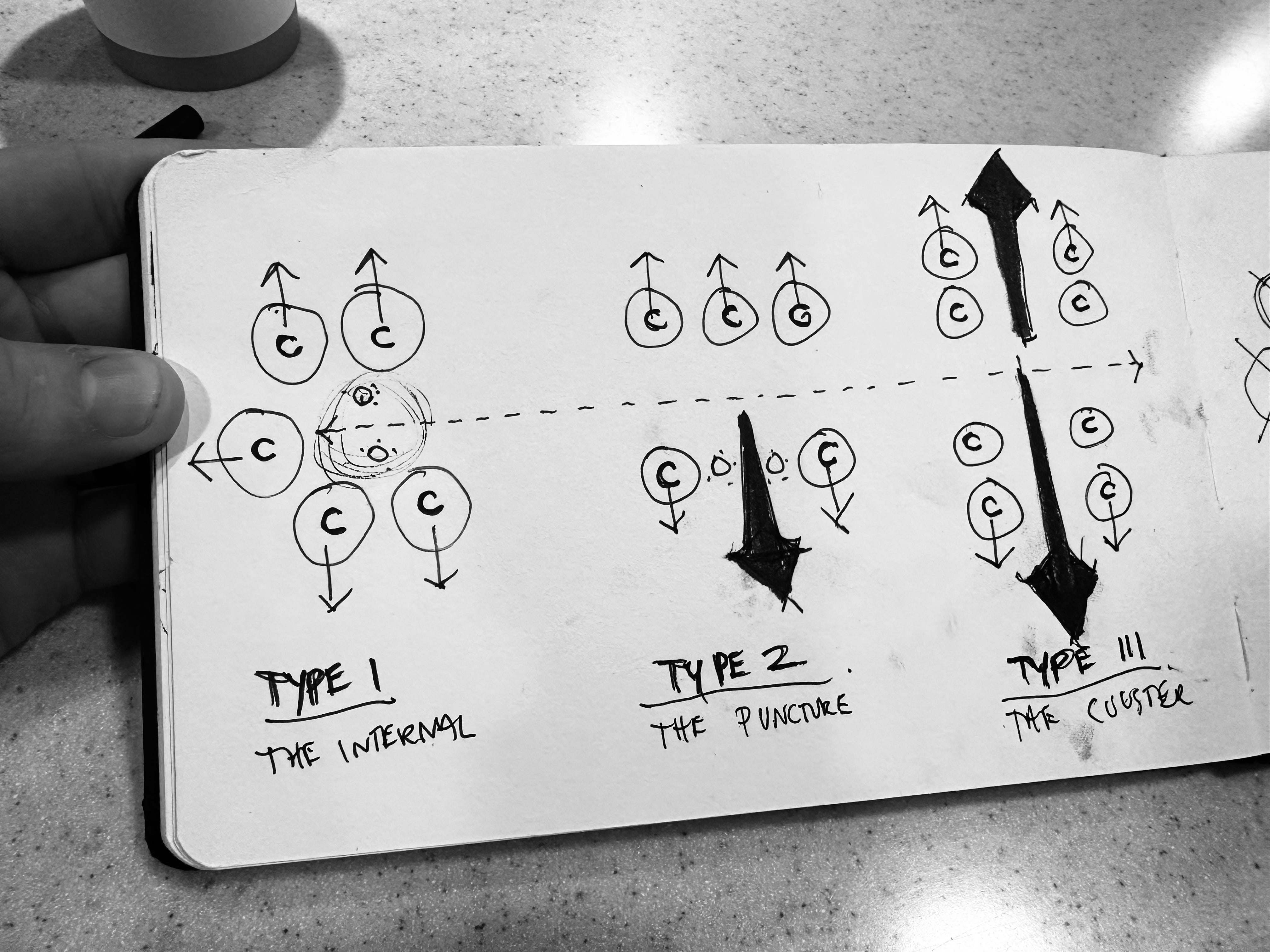
The ideal Learning Neighbourhood will have the following key identifiers:
Maximum 5 classrooms (150 students @30 children)
Shared project space
Identifiable features to distinguish from the other parts of the school
Minor support spaces
Neighbourhoods create a space with a maximum of 150 students where students can feel belonging, identity, and collaboration.
CLIFF TRAIL ELEMENTARY SCHOOL
Cliff Trail Elementary is a great example of this principle in practice.
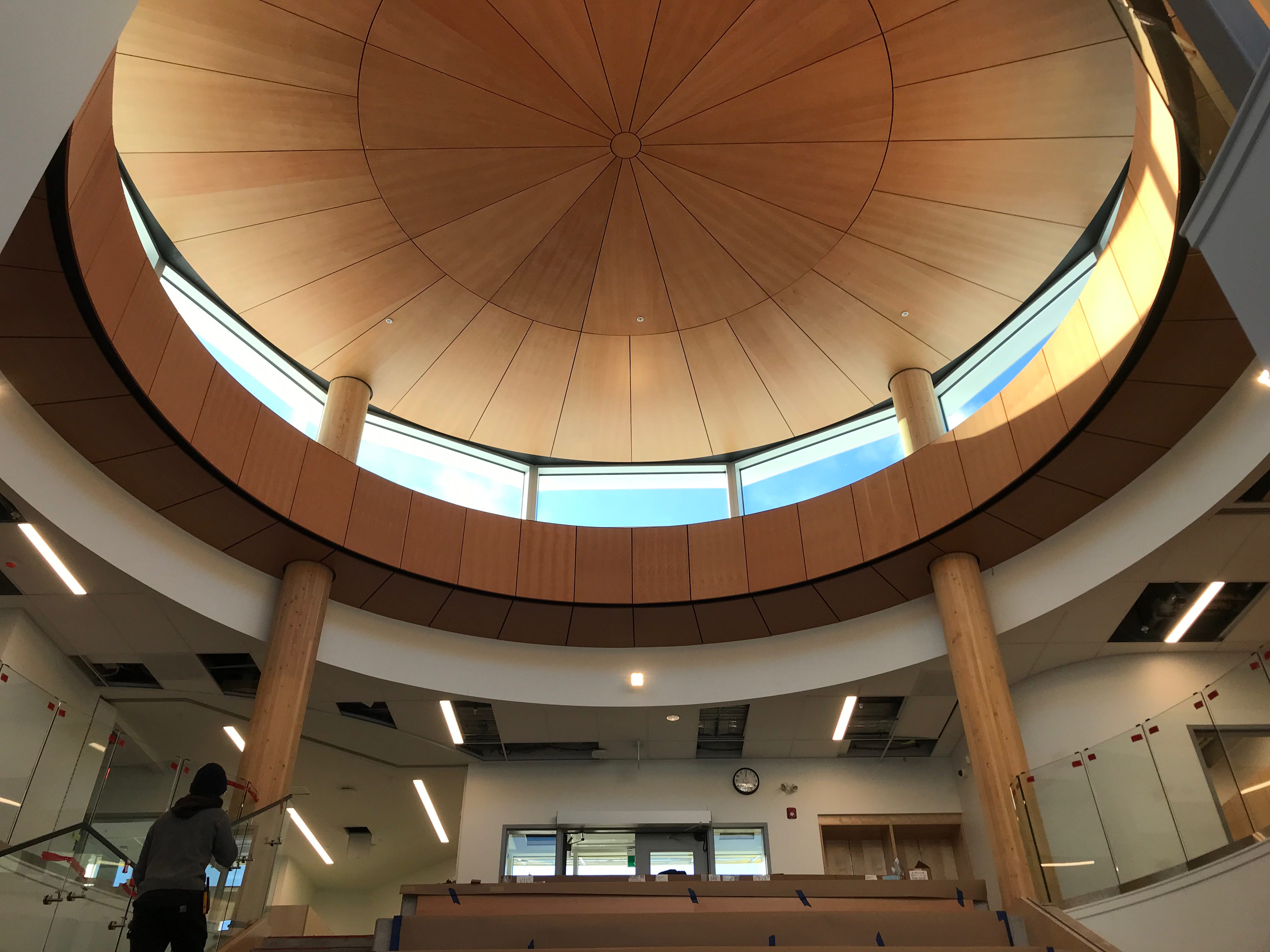
The school is located about 20 mins north of Whitehorse, Canada. It is so far north, it almost gives Alaska a challenge for it’s brutal environment. The school is designed to fit 425 students and includes two gymnasiums, music room, foods room, and STEAM, and elders spaces. The building is organized with two primary wings - academic, and athletic - separated by the heart of the building, which is a circular space with a two-story sit-stair.
The academic wing is organized into a series of Learning Neighbourhoods that are all clearly identified through colour. This colour is used within the classrooms, in the project learning spaces, and on the exterior of the building. These “pods” as they have now been named create a unique identity and wayfinding for students and parents to easily find. The design of each pod centers around the principles of the rule of 150 limiting the number of classrooms within the pod to 4. (The rule of 150 allows these pods to extend to 5 classrooms, but was not needed in this case).
This colour coded pod approach creates unique communities of grouped classrooms throughout the school which supports a sense of growth because each pod supports multiple grade levels.
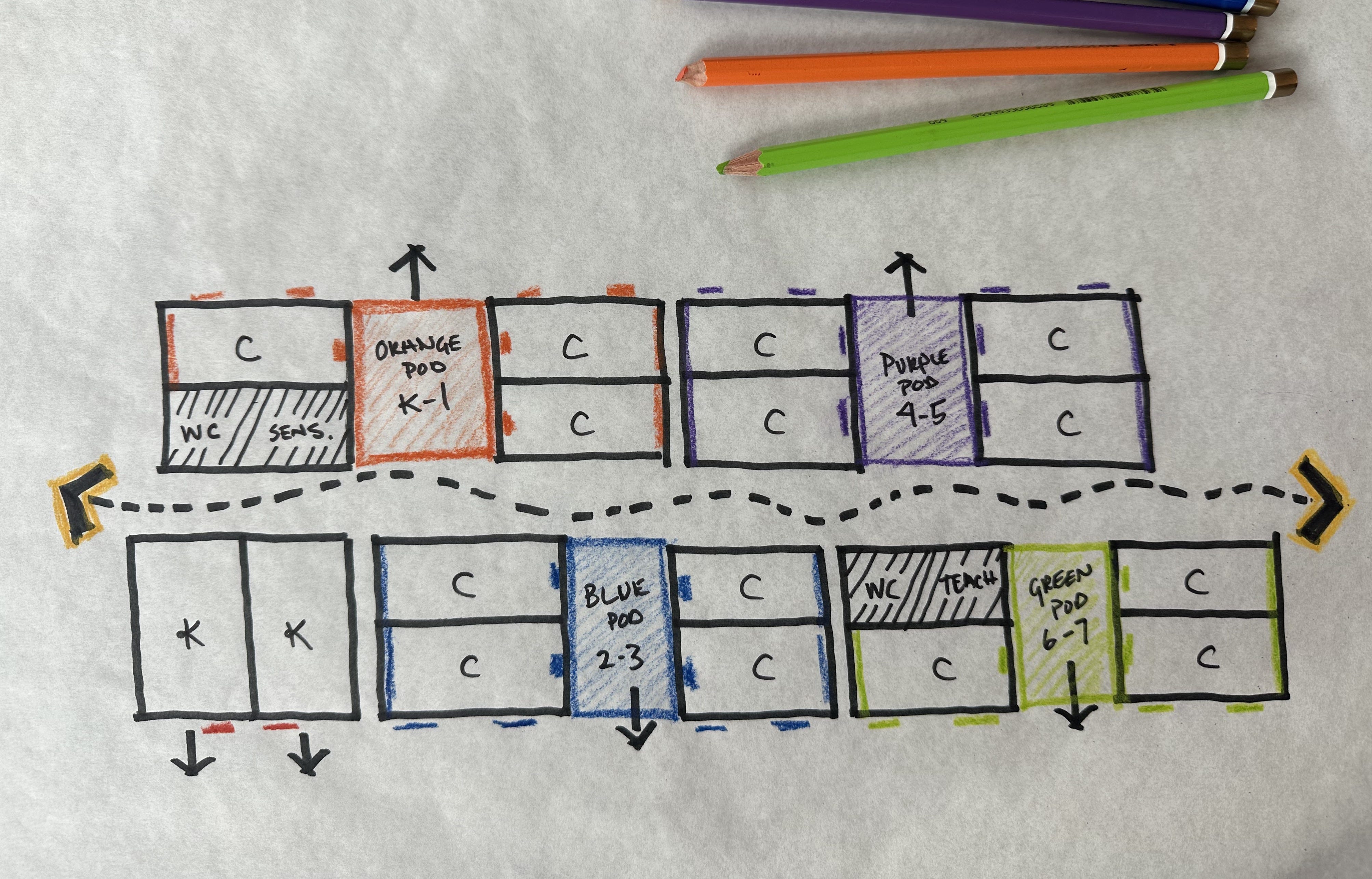
Orange Pod = K-1
Blue Pod = 2-3
Purple Pod = 4-5
Green Pod = 6-7
The kids understand that every two years they are moving up to another pod, so they enter the school as an orange member and leave as a green one. It’s a system for incremental growth and it’s one that’s simple to understand and explain. This matters for kids. The world is complex, and a simple system like this allows them to see how they fit in the world.

The final way that colour was used within the school to support wayfinding and identity is through the entryways to the building. These have all been provided with yellow cladding to support their easy visual accessibility from all points of the site.
Schools aren’t just regular buildings, they are places of growth, learning, and support for our future citizens. The architecture can support that growth and enhance it.
*This Architect of Record for this project was Northern Front Studio and Thinkspace Architecture Planning Interior Design was the Design Architect.
CARBON + ARCHITECTURE 101
If you follow my content regularly, you know I write alot about carbon reduction. My guide Carbon + Architecture 101 will take you further into the topic with diagrams and anaologies. It breaks down embodied, operational, and whole-life carbon into clear, actionable insights — no fluff, no complexity. Built for busy professionals who want to make smarter low-carbon decisions starting now.
It’s on sale for $15 CAD. Get your copy here.
Gladwell, M. (2000). The magic number one hundred and fifty. In The tipping point: How little things can make a big difference. Little, Brown and Company.
Gladwell, M. (2000). The magic number one hundred and fifty. In The tipping point: How little things can make a big difference. Little, Brown and Company.